
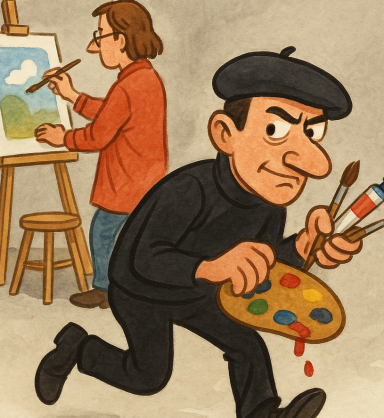
Steal Like an Artist: What They Don't Tell You About Copycat Culture
Mahalia Crotz-Kerbs
In art school our professors would tell use in a blasé manner that all artist steal. They taught us how to steal and what the obscure phrase meant. By the time I graduated the phrase “Steal like an artist”, was catching on like wildfire made popular by author Austin Kleon (2012), the catastrophe of this popularity was that, without the prober training, the phrase would became ubiquitous to justify theft in the art world.
Somewhere along the way, “Steal like an artist” has been twisted into an excuse for plagiarism, mimicry, and appropriation—especially in the digital age. In this blog, we unpack what the phrase actually means, how it’s been dangerously misinterpreted, and why this misreading has opened the door to widespread copyright abuse and undervaluing of original works.
What “Stealing Like an Artist” Originally Meant
Austin Kleon’s intent was simple: all artists are inspired by what came before. Creativity is a remix of influence, memory, and reimagination—not a blank slate. To “steal” like an artist is to digest, study, and transform, not to copy and paste. In art circles there is a free flowing exchange of ideas and feeding one another the vital energy of creativity. Yes, we are naturally competitive for those geniuses who dare to darken us with their shadows. And yes, we have mad respect for the artist(s) other who strive to reach past their limitations. But above all we know where the line is.
How the Phrase Got Twisted — and Weaponized by Print-on-Demand Plagiarists
The phrase “Steal like an artist” was never meant to justify theft. And hindsight being what is 20/20 and all that, it probably should never have left the inner circle. But in the hands of opportunists, it became a smokescreen for something far more exploitative.
I
But the theft wasn’t limited to action—it came with a sermon.
These resellers deliberately spread misinformation, insisting that protecting your work was “pointless,” “elitist,” or “a waste of energy.” Blog posts, YouTube channels, and social groups began promoting the idea that once you post your work online, you’ve essentially relinquished your rights. They parroted phrases like:
- “Nothing is original, anyway.”
- “Art is meant to be shared.”
- “Real artists don’t care about money.”
- “It’s better to move on and make more art.”
Behind the faux-philosophy was a very real con:
If artists could be convinced that copyright didn’t matter and where too costly to maintain, they wouldn’t fight back.
- “Copyrighting your art is expensive and complicated.”
- “If you had a copyright for every piece you made, you’re just waisting your money because it’s not a guarantee your work is protected.”
- “Litigating your ownership is costly and the lawyer and court fees!”
Steal Like an Artist cont...
This scare tactics weren’t harmless. It created a toxic culture where:
- New artists hesitated to price or watermark their work.
- Creators internalized guilt for asking to be paid.
- The value of originality was slowly chipped away.
This misinterpretation of “stealing like an artist” didn’t inspire—it disarmed. It turned ethical boundaries into blurry suggestions and made it easier for people to exploit without accountability.
Once the groundwork was laid—once creators had been systematically told not to defend their work—a new wave of technological exploitation emerged. It didn’t just scrape Pinterest boards. It scraped the entire internet.
Generative AI models like Stable Diffusion, Midjourney, and others were trained on millions of pieces of copyrighted art—without permission, attribution, or compensation. The same cultural apathy that print-on-demand thieves fostered was now powering machines that could mass-produce mimicry with terrifying ease.
And at the center of this storm is a broken copyright infrastructure—one that artists are still expected to navigate alone. Because let’s face it, lawyers are expensive.
We’ll examine that more deeply in our next article, which looks at AI infringement, the role of the U.S. Copyright Office, and how the recent dismissal of Shira Perlmutter might shape the future of creator rights.
The Real-World Fallout: Undervalued, Unprotected Artists
The misinterpretation has serious consequences:
- Emerging artists stop pricing properly because they believe that fair market price of their work is “gatekeeping”.
- Original creators lose visibility as copies out-algorithm the source.
- Artistic styles are farmed for profit by corporations or AI tools without permission or credit.
- Young creatives are being taught that originality doesn’t matter, just trendiness.
Inspiration vs. Infringement: Where’s the Line?
The difference is respect and transformation.
- Inspiration is when Basquiat nods to Picasso’s forms but speaks in his own voice.
- Infringement is downloading someone’s illustration, slapping your logo on it, and selling it.
Reclaiming the Right to Protect and Price Our Work
Artists need to feel empowered to:
- Say no to theft, no matter how “small.”
- Understand copyright law (and not feel ashamed for using it).
- Price for value, not trend.
- Educate clients and other creatives about the importance of ethical artistry.
- Set up tracking systems of their works before uploading it to social media and sharing platforms use features. (Link source article teaching artist how to set up a tracking system.)
Steal Wisdom, Not Work
The phrase “Steal like an artist” was meant to encourage transformation—not imitation. And to be clear: I don’t place the blame on Austin Kleon or his book. I actually enjoyed Steal Like an Artist when I first read it. His intention was to remind us that creativity builds on creativity—that we are shaped by what we absorb and what we love.
The tragedy is not in the phrase itself, but in how it was twisted.
Thieves will always find ways to steal. But it’s a shame that his message was distorted and weaponized to serve the needs of opportunists—hurting a generation of artists who are now struggling to navigate a new, exploitative era of technology and automation.
Let’s retire the misuse.
Let’s teach the difference.
Let’s protect the creators who’ve been told for too long that their work isn’t worth guarding.
If you’re ready to learn how to protect your creativity—through copyright, contracts, and confidence—
subscribe to the MinkBerry™ newsletter for tools, insights, and real-world strategies made by artists, for artists.