
A Library From The Ashes: The Birth Of America's Creative Vault
Mahalia Crotz-Kerbs
When you hear the phrase Library of Congress, what comes to mind? A massive building with old books? Maybe a government archive buried deep in paperwork? Or a Musume covered in Italian Marble and gold? It is these things and more. This library is one of the most powerful engines behind creativity in the United States—and even the world?
From Private Bookshelf to National Treasury
Let’s rewind to 1800. The United States was still a young country when President John Adams approved a law to create a library for Congress. His goal was to furnish congress with books to read when U.S. Congress moved to Washington. Congress would meet in New York and then in Philadelphia having access to either the New York Society Library and later the Free Library of Philadelphia.
Pres. Adamas allotted congress $5,000 (adjusted for inflation, that’s $126,904.37 as of 2025) to furnish their new library. But that’s not the true beginning of what the Library of Congress is today. That honor truly belongs to Thomas Jefferson—yes, our troublesome forefather—who gave it its actual shape.
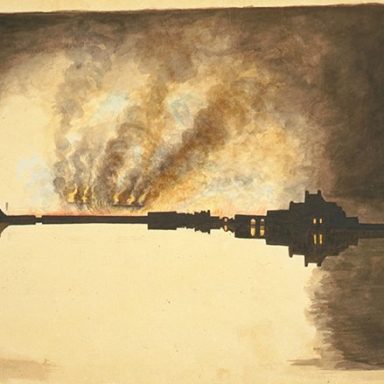
Those darn Brits were at it again. Upset that they lost the Revolutionary war, they came back for round two and burned down the original library during the War of 1812, not to mention the White House, but that’s a story for another day. After the smoke had cleared and we sent those buggers back home with their tails between their legs a second time, Jefferson offered something incredible: he sold Congress his personal library of over 6,000 books (worth way more than $5,000). That sale didn’t just rebuild the collection—it rewired its entire purpose.
Jefferson believed that “there is in fact no subject to which a member of Congress may not have occasion to refer.” His collection spanned not only law and politics but art, science, history, agriculture, and even cookbooks. From that point on, the Library of Congress became more than a bookshelf for lawmakers—it became the keeper of the nation’s knowledge. And the many creatives in these United States have been consummate contributors.
It gives me chills just thinking about it. I tell you if you have never had the chance to visit this amazing library, go. Go, and don’t just take the guided tour of pristine marble and golden pillars. Don’t just ogle the breathtaking frescos and Micheal Angeloest painting on the ceilings. Don’t be content with just standing on the viewers’ balcony. Get your library of congress card and step onto the floor! It is absolutely the bibliophiles’ wet dream come to life.
A Library from the Ashes cont...
More Than Books: A Copyright Powerhouse
So this is mainly a copyright blog and what does the Library of Congress have anything to do with copyright?
A lot, actually.
Most people don’t realize that the Library of Congress is home to the U.S. Copyright Office—I’m sure many have come to learn this recently, but we’re not getting into that here, not yet anyway.––it’s a vital system that helps creators protect their work. If you’re an author, musician, game designer, choreographer, filmmaker, or even a YouTuber writing original content, the Library of Congress is where your rights begin.
When you register your creative work for copyright, you’re not just getting legal protection—you’re also contributing to a growing national archive. The Library doesn’t just store books; it preserves everything from sheet music to software, from TikTok scripts to architectural drawings. That makes it the most complete public collection of creative expression on Earth.
** Side note: The architects of the new library wanted the United States Library of Congress to be the one of the wonders of the world, much like the Library of Alexander. We have Surpassed the amount of knowledge and books that were once held in Alexandria’s house with the Library of Congress holding over 167 million items, where 38.6 million of that astronomical figure are books and other printed materials. Just accounting for the latter, that’s 96.5 time more books and printed materials than the Library of Alexandria!
The Librarian of Congress: Keeper of Culture
Presiding over this cultural giant is the Librarian of Congress. This isn’t just someone who loves books (though it’s undeniably one of their passions). The Librarian plays a powerful role in protecting and promoting the arts and sciences. They're appointed by the President and confirmed by the Senate.
One of their biggest jobs? Appointing the Register of Copyrights—the person in charge of managing the entire U.S. Copyright Office. The Librarian’s position gives them significant influence over creator protection, copyright law interpretation, and the national archive’s adaptation to new technology.
Think of the Librarian as a national curator, a sort of intellectual DJ who helps keep America’s playlist spinning. Whether it’s jazz recordings from Harlem, poems from the Dust Bowl, or video games coded in a basement last week—this office is the epicenter of American culture and history.
Common misconception
Becaus all the records and registered archives, literary tombs, music and art, to name a few of the Library of Congress’ inhabitants. People believe these works are public domain. This is further from the truth. All works that are registered with the United States Office of Copyright, a deposit of those works, are made there. These deposits are for preservation, record keeping, and held as a specimen in case of litigation. (Jade please expand this section one more ¶)
A Living Archive for Everyone
The second misconception that people may have is that they believe is that the Library of Congress is just for Congress. It isn’t, it’s for you.
You can access its digital collections from anywhere in the world. Want to read an 18th-century map? Listen to a slave narrative? Study rare photography or watch early silent films? It’s all there. And it’s all free. The Library is living proof that when a nation values its creative minds; it preserves them—not just for today’s lawmakers, but for tomorrow’s artists, thinkers, and builders.
Creative Covenant
“Let the wise hear and increase in learning, and the discerning obtain wise counsel.” — Proverbs 1:5, CJB
Knowledge is not just for the few but for the masses. It is a wealth a nation must give freely to her people for them to live in perpetuity and advance.